
[July 2026 edition]
Part 2: Give AI a "Cerebellum" and "Autonomic Nerves" — A Blueprint for Embodied Intelligence
Published: Jul 8, 2026
Reading time: ~6 min
If the LLM is the “cerebrum,” where are the cerebellum and spinal cord?
Last time, I laid out that the mainstream of Physical AI is a composite of “LLM/VLM meaning-understanding + diffusion/flow motion generation + world model.” From here, let’s push one step further.
Likening the LLM—which grew mainly from text data—to the human brain, and specifically to the cerebrum, is surprisingly apt. Language, knowledge, reasoning, planning: these overlap well with the higher functions the cerebral cortex handles.
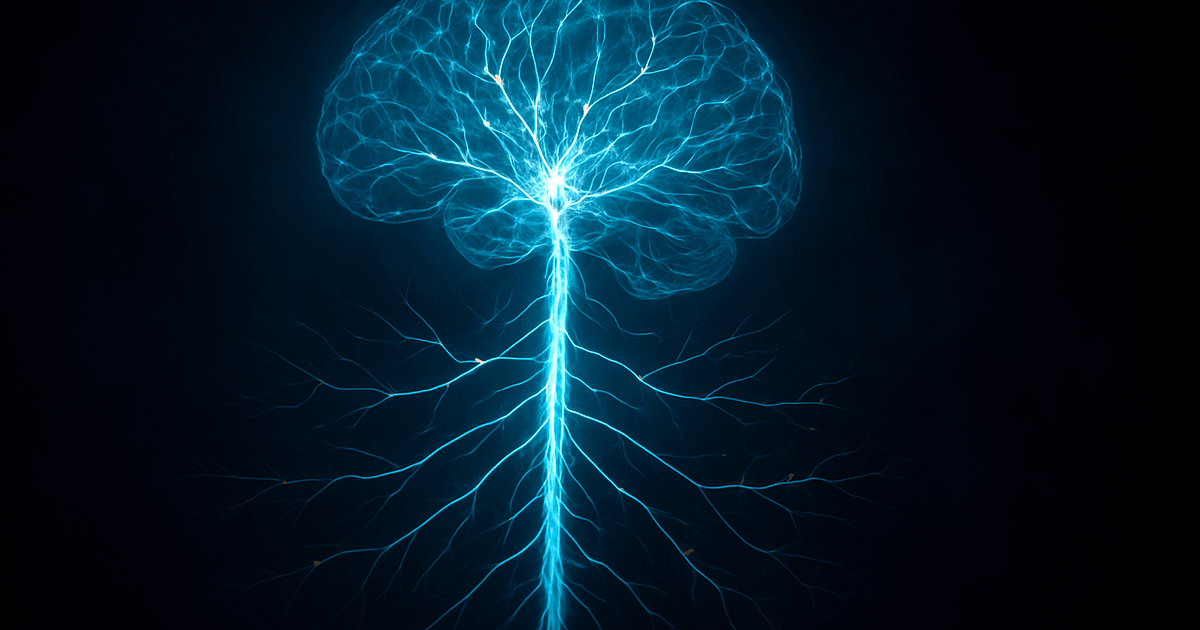
But then, naturally, you think this: if there’s a cerebrum, shouldn’t there also be equivalents of the cerebellum and spinal cord—“brains closer to the body”? Humans have not only mechanisms to move limbs but also physiological feedback from internal organs like the heart, stomach, and gut. There should be equivalents of the autonomic nerves—the sympathetic and parasympathetic systems—that govern them.
Interestingly, this intuition lines up quite well with the direction of current Physical AI research. Rather than “making the LLM itself more like the human brain,” researchers have begun heading toward “rebuilding a hierarchical structure like the human nervous system as an AI system.”
The correspondence between the human body and an AI system
Lining up parts of the human body with AI candidates gives a clean hierarchy.
| Human body | AI candidate |
|---|---|
| Cerebral cortex | LLM / VLM / MLLM (knowledge, reasoning, language, planning; e.g., Gemini Robotics-ER) |
| Frontal-lobe planning | Task planner, symbolic planner |
| Cerebellum | Motor learning, posture control, error correction (Diffusion Policy, Flow Matching, RL, MPC) |
| Spinal reflex | Real-time control, emergency stop (MPC / PID / safety controller) |
| Autonomic nerves | Resource management, safety control, anomaly detection |
| Endocrine system | Internal-parameter tuning such as learning rate and exploration rate |
| Sensory organs | Camera, LiDAR, microphone |
| Somatosensation | Tactile sensor, force sensing, proprioception |
| Interoception | Battery, CPU temperature, motor current, fault diagnosis |
| World prediction | World model / simulator |
What today’s Physical AI covers thickly is the top two or three tiers—the cerebrum (LLM/VLM) and part of the motor control that corresponds to the cerebellum and spinal cord. The lower tiers, especially the autonomic-nerve and interoception areas, are still mostly blank. In this article, I’ll walk through those blanks in order.
The artificial cerebellum: the “motor-error correction” LLMs are bad at
Let’s start with the cerebellum.
The LLM can think about “what it wants to do.” But “if you grip the cup 3mm to the right it slips” or “loosening your fingers a bit makes it succeed”—this fine correction of motor error is something it’s bad at.
It’s the same in humans: this is the cerebellum’s job, not the cerebrum’s. If the cerebrum inferred “move the right foot 5mm forward, bend the knee 2 degrees…” dozens of times a second with every step, there’d be no room for conversation. Fine motor control is left to a separate circuit called the cerebellum.
That’s why recent Diffusion Policy and Flow Matching can be seen as close to an “artificial cerebellum.” The diffusion-based action generation we saw in Part 1 plays a cerebellum-like role—taking on the fine-tuning of motion beneath the cerebrum (the LLM).
This division is made explicit even in company models. NVIDIA’s GR00T N1 calls its vision-language module “System 2” and its diffusion transformer “System 1”—the former interprets the environment and language instructions, the latter generates real-time motion, a dual structure that is exactly cerebrum/cerebellum-like (GR00T N1 paper). Figure AI’s Helix, too, is a VLA that emphasizes high-frequency continuous control of the whole upper body, fingers, and wrists, described as a model that separates meaning-understanding from fast motor control (Figure: Helix). The idea of separating “the cerebrum that thinks it through” from “the cerebellum that moves reflexively” is now becoming a standard design in research.
Interoception: a robot’s “physical condition”
Next is the easily overlooked interoception.
Humans don’t perceive only the outside world. Heart rate, breathing, hunger, fatigue, pain, body temperature—they keep sending “internal body” information to the brain. In recent neuroscience, this interoception is thought to be deeply involved in decision-making and the formation of emotion.
Robots have the same kind of information:
- Battery level
- Motor temperature
- Joint torque
- Gear wear
- Vibration
- CPU usage
- Communication latency
These are not mere monitoring logs. They are the robot’s “state of physical health.” In future Physical AI, this internal information is expected to become a learning target too—perceiving not just the outside video but its own condition, and changing behavior accordingly.
Autonomic nerves and homeostasis: the most missing layers
Finally, let me name the two things today’s AI most lacks.
One is whole-body mode switching equivalent to the sympathetic and parasympathetic nerves. In humans, sensing danger automatically triggers a chain of state transitions: heart rate rises, vision narrows, motor ability is prioritized, digestion halts. But AI is usually just “camera image → inference → action.” It really ought to switch the whole body according to an internal “danger state”—raise inference frequency, increase safety margins, change sensor weights, slow down its actions. This is neither an LLM nor a diffusion model’s job; it’s “state control of the whole system.”
This direction is starting to move in research too. Google DeepMind’s Gemini Robotics-ER 1.6 is positioned as an embodied-reasoning model that, rather than driving motors directly, handles spatial understanding, physical safety, and the sequencing of actions, taking images, video, audio, and natural language as input and contextualizing the physical world (Gemini Robotics-ER 1.6). Its ability to comply with physical safety constraints is reported to have improved (model card), and this layer that judges “is it dangerous, is it possible, how should it be sequenced” is closer to the cerebrum/frontal lobe than the cerebellum—and close to autonomic-style mode control.
The other is homeostasis. Whatever they’re doing, humans keep body temperature, blood sugar, oxygen, water, fatigue, and sleep within a certain range. Today’s AI, by contrast, concentrates on “carrying out the given task” and barely considers maintaining its own state. If robots that operate autonomously over long periods become common, then not only “achieving the goal” but also maintaining homeostasis—“not breaking yourself, managing energy, and resting or recharging at the right time”—will be indispensable.
This view overlaps with the research frontier
Everything so far is not an off-the-cuff metaphor. It overlaps firmly with recent research themes.
In particular, fields like Embodied AI, Developmental Robotics, Active Inference, and the Free Energy Principle increasingly hold that “intelligence is not only the ability to understand the outside world, but the ability to interact with the environment while maintaining one’s own body state.”
Over the next 5–10 years of Physical AI, rather than “the race to make LLMs smarter,” there’s a good chance that architectures that integrate the whole body—the “artificial cerebellum,” “artificial autonomic nerves,” and “artificial homeostasis”—will become major research themes. It’s a system design one level above the VLA and world models we saw in Part 1.
Summary
- Likening the LLM to the “cerebrum” is reasonable—but the layers for cerebellum, spinal cord, autonomic nerves, and interoception are still blank
- The artificial cerebellum = Diffusion Policy / Flow Matching takes on motor-error correction, a job the cerebrum is bad at
- A robot’s internal information (battery, temperature, torque, wear) is its “physical condition,” and will become a learning target
- What’s most missing is whole-body mode switching in danger (autonomic nerves) and the homeostasis to keep oneself intact
Next time (Part 3), I’ll dig into why “doing everything with a single giant model” is a poor idea—backing up this blueprint from the angles of hierarchy, separation of responsibilities, and resource efficiency.